Location:
PMKI > Organizations
& Governance > Program Management.

- Program Management Overview
- Differentiating Programs from
Projects
- Useful External Web-links &
Resources.
Other related sections of the PMKI:
- Defining Projects and Programs, Typology
Program management is the coordinated management of a
group of related projects to achieve a set of business
objectives by obtaining benefits and control not available
when managing the projects individually. A program may
consist of:
- a group of projects that benefit from a consolidated
management approach,
- a group of projects that contribute towards one specific
objective, or simply
- a group of projects that benefit from the coordinated
support, planning, prioritization, and monitoring of
projects to meet changing business needs.
Program managers ensure that processes they use meet the
business needs that are defined in terms of program life
cycles and tailored to the underlying activities'
characteristics. General program management activities
include ensuring that:
- Investments are made in the right products, and
- The quality of the output meets the required standard.
A Program Manager provides the assessment, measurement, analysis, support, and reporting of enterprise-wide project performance and departmental process improvement activities, and facilitates communication and coordination between Project Managers, Functional Managers, Self-Directed Teams, and Customers.
This section focuses on the elements of program management that are different to project management.
Note: the English and ISO spelling of programme and the more common spelling program refer to the same type of entity.
WP: Program Management. Program management focuses on the coordination of a number of related projects over time to deliver benefits that would not be available if the projects were managed separately.
DP: PWC 4th Global Portfolio and Programme Management Survey. When will you think differently about program delivery?A review of the value of program management to organizations.
WP: Defining Program Types. A methodology for differentiating program types.

The Standard for Program Management –
Fourth Edition. The Standard for Program Management
defines a set of processes that represent generally
recognized good practices in program management, as well
as promote efficient and effective communication and
coordination, among various project management groups.
DP: A Framework for Performance Based Competency Standards for Program Managers. Developed by GAPPS, this framework for performance based competency defines the competencies needed by three levels and six types of program manager.

 Projects
and Programs are different! Unfortunately, this difference
has been ignored or confused by many people for too long.
Project management is focused on the efficient creation of
a known deliverable; project managers should be seeking to
minimize ‘unnecessary’ change to create their specified
deliverable as efficiently as possible. Program management
focuses on the coordination of a number of related
projects over time to deliver benefits to the
organization; program managers should be actively seeking
to adapt future effort to maximize benefits as the
situation unfolds. Using project management processes to
deliver a program generally will not work (although many
of the tools are superficially similar). The challenge
facing organizations is to know the difference between a
major project and a program and then apply the optimum
management approach. In both situations an appreciation of
the ideas contained in ‘Complexity
Theory’ and CRPR in particular will add a depth of
understanding to a complicated situation.
Projects
and Programs are different! Unfortunately, this difference
has been ignored or confused by many people for too long.
Project management is focused on the efficient creation of
a known deliverable; project managers should be seeking to
minimize ‘unnecessary’ change to create their specified
deliverable as efficiently as possible. Program management
focuses on the coordination of a number of related
projects over time to deliver benefits to the
organization; program managers should be actively seeking
to adapt future effort to maximize benefits as the
situation unfolds. Using project management processes to
deliver a program generally will not work (although many
of the tools are superficially similar). The challenge
facing organizations is to know the difference between a
major project and a program and then apply the optimum
management approach. In both situations an appreciation of
the ideas contained in ‘Complexity
Theory’ and CRPR in particular will add a depth of
understanding to a complicated situation.
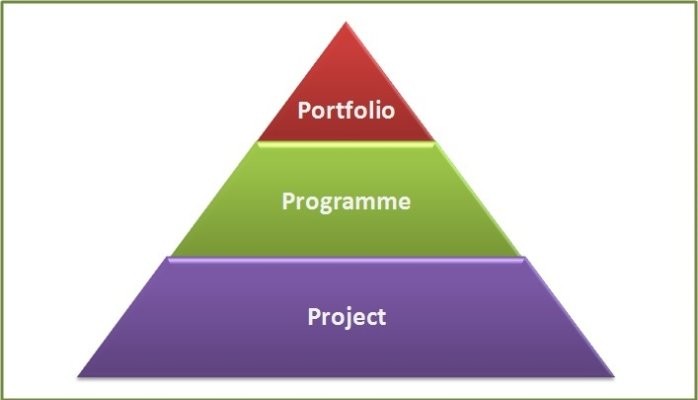
From a governance and stakeholder management perspective the expectation of 'on time and on budget' that has some relevance to project governance is usually counterproductive in program management space where the focus needs to be on benefits realization and value management. From the very beginnings of modern project management, there has been confusion in the terms; the Manhattan ‘project’ to create two completely different ‘atom bombs’ involved numerous major projects such as the construction of major factories and the operation of those plants. The Manhattan ‘project’ was by all modern definitions a full blown program of work. A decade later, the Atlas ‘program’ to design and build a new missile for the USA was called a program. This confusion continues in many quarters to the current day. Both the OGC and the APM in the UK and PMI in the USA seem to have agreed that organizations have one or more Portfolios of projects and each portfolio contains a number of programs and projects. Program management focuses on the coordination of a number of related projects over time to deliver benefits to the organization and projects are about the efficient delivery of an outcome. The boundary that needs to be drawn much more sharply, and the focus of this paper, is between projects that are initiated to create a known deliverable and then shut down and programs that are initiated to create a change and/or realize benefit(s) for the host organization; adapting to circumstances as conditions change and using projects to create individual deliverables within the overall matrix of the program. These different focuses have major consequences on the style of management and using project management processes to deliver a program generally will not work (although many of the tools are superficially similar).
Program managers should be actively seeking to adapt future effort to maximize benefits as the situation unfolds. Project managers should be seeking to minimize ‘unnecessary’ change to create their specified deliverable as efficiently as possible. The key difference between a project and a program of works can be described as:
Whilst it is absolutely possible and often desirable to contract a ‘project’ to an independent third party (eg, the developer of a shopping complex can easily contract the building of the center to a construction company), it is virtually impossible to effectively contract out the program management role, the program manger has to be an integral part of the organization's strategic business. The publicized ‘failures’ of a number of so-called major projects, particularly in the Defence and ICT arenas would appear to be caused by the clients attempting to procure a complex program of work (frequently involving significant elements of R&D) as a simple ‘fixed price’ project in a perversely misguided attempt to offload ‘risk’. The challenge facing organizations is to recognize the difference between a project and a program and then apply the optimum management approach.
PP: Understanding Programs and Projects - Oh, there's a difference! How to differentiate between a major project and a program and then apply the optimum management approach.This paper:
WP: Differentiating Programs from Projects. A methodology for differentiating projects and programs.
Blg: Differentiating normal, complex and megaprojects. A look at the additional layers of competency needed to manage complex projects and megaprojects and a suggested framework for classifying these different types of project.
Best Management Practice products, UK Government
(formally OGC, now Axelos) - the umbrella site dedicated
to making access to information quick and easy - https://www.axelos.com/
- MSP - Programme Management: https://www.axelos.com/best-practice-solutions/msp
 For papers on Program Management presented
at the PGCS Annual Symposium see:
For papers on Program Management presented
at the PGCS Annual Symposium see: