Location:
PMKI > Stakeholder
Management > Advanced Stakeholder Engagement


- Stakeholder Overview
- Stakeholder Theory and Research
- Practical Stakeholder Engagement
- Useful External Web-links &
Resources.
Other related sections of the PMKI:
- Project Relationship
Management and the Stakeholder Circle®
A
dissertation submitted as part of the requirements for
the degree of Doctor of Project Management
- The Stakeholder Relationship
Management Maturity Model (SRMM®)
- Communication Management:
communication in a project management context
- Project Management in
the time of COVID.

A stakeholder is an individual, group or organization that:
This definition breaks down into stakeholders being:
Project Stakeholder Management focuses on understanding the key concepts and benefits of stakeholder engagement and the relationship between stakeholder satisfaction and project success. To achieve this objective, the project teem need to :
The concept of stakeholders seems to have emerged initially in the systems analysis work on organizations conducted by researchers at the Tavistock Institute in London in the late 1960s and early 70s. Since then, both the concept and the spread of people and organizations covered by the term ‘stakeholder’ seem to have expanded and evolved and are continuing to change. Project success and failure is directly related to its stakeholders' perceptions of the value created by the project and the nature of their relationship with the project team. This is strongly influenced by both the expectations and perceptions of its stakeholders, and the capability and willingness of project managers to manage these factors and effectively engage with the organization's politics.
WP: Valuing Stakeholder Management Stakeholder Engagement is free! This White Paper sets out the zero cost of stakeholder relationship management, based on the philosophy of the Quality movement that quality is free – investment in stakeholders is balanced by reduction in ‘failure dollars’ of fixing the issues caused by poor stakeholder relationship management. A properly equipped PMO is ideally placed to champion and facilitate this approach and provide not only support services to achieve this, but also assist in measuring ‘failure dollars’ through its reporting mechanisms.
.

Our research was designed to improve a project's chances for success by identifying ways to develop effective relationships with these key stakeholders, and through refinement and testing of the Stakeholder Circle®, develop an effective way to provide support for the project manger and project team to build and maintain relationships with the right stakeholders at the right time. See more on Dr. Lynda Bourne's research thesis.
The project team benefits from use of the Stakeholder Circle®, or another effective methodology, through engaging in the sharing knowledge about each of the stakeholders, and through the act of negotiating for agreement on the relative importance of each stakeholder which helps build team relationships. These experiences contribute to the growth of the project team members. And their organizations benefit from the increased awareness of the project team members of the importance of project relationship management and knowledge of how to achieve it. An additional benefit will arise from a decrease in failed projects with the consequential decrease in wasted funds and resources. We believe the approach to project relationship management in the form of the theory implicit in the Stakeholder Circle® methodology and visualization tool will increase the value of projects to organizations, and their continuing success will improve the reputation of the project management profession.
PP:
A Typology of Operational Approaches for Stakeholder
Analysis and Engagement.
 Stakeholder
analysis and engagement are the main tasks in stakeholder
management. To identify practical approaches and measure
the effectiveness of the approaches for stakeholder
analysis and engagement, six interviews and a
questionnaire survey were conducted in Hong Kong, and
fifteen interviews were held in Australia. A typology of
approaches is proposed based on literature review, and
these empirical studies. Two case studies were conducted
to illustrate the selection and application of the
approaches. Findings from this study show that the success
of a particular stakeholder management technique depends
on internal and external factors, such as the nature of
the project, the resources in the organization, and the
communication environment. Each approach has its strengths
and limitations, so the best way to define a practical
technique for effective stakeholder management is to use
combinations of elements from each method as circumstances
dictate.
Stakeholder
analysis and engagement are the main tasks in stakeholder
management. To identify practical approaches and measure
the effectiveness of the approaches for stakeholder
analysis and engagement, six interviews and a
questionnaire survey were conducted in Hong Kong, and
fifteen interviews were held in Australia. A typology of
approaches is proposed based on literature review, and
these empirical studies. Two case studies were conducted
to illustrate the selection and application of the
approaches. Findings from this study show that the success
of a particular stakeholder management technique depends
on internal and external factors, such as the nature of
the project, the resources in the organization, and the
communication environment. Each approach has its strengths
and limitations, so the best way to define a practical
technique for effective stakeholder management is to use
combinations of elements from each method as circumstances
dictate.
Authors: Dr. Jing (Rebecca) Yang. Deakin University
Prof. Ping Qi (Geoffrey) Shen, Hong Kong Polytechnic
University
Dr. Lynda Bourne, Mosaic Project Services Pty Ltd
Christabel MF Ho & Dr. Xiaolong Xue
PP: Practice Note: Advancing theory and practice for successful implementation of Stakeholder Management in organizations. This paper firstly, describes the evolution of the Stakeholder Circle® from a research tool into a commercial project management tool and then into a maturity model (SRMM®) that describes the ‘readiness’ of an organization to successfully implement a stakeholder management culture and practice. Click through to see more on the SRMM Model.
PP: The Paradox of Project Control in a Matrix Organisation. This paper explores the hypothesis that, within complex matrix organizations, the ‘zone’ between the strategic vision set by senior management and the projects created to fulfill it, is a highly complex and dynamic organism that's reaction to stimuli cannot be predicted. Succeeding in this environment needs a different management paradigm from that developed for management in traditional project industries. The characteristics of a complex matrix organization include: multiple/competing lines of authority, virtual and partial/part time teams, divergent objectives, and many competing levels and types of authority. This paper describes the paradigm shift in management thinking needed to succeed in managing projects across this ‘zone’. To succeed, managers need to combine vigilance and agility to identify and capitalize on unexpected gains and deal with unexpected problems.
 Can
a project be ‘on time’, ‘on budget’ and a failure despite
delivering 100% of its scope? The short answer is
yes! But it is also possible for a project to be
over budget, over time, missing scope and an iconic
success. This papers in this section demonstrate that
delivering value (time, cost and scope) is only one aspect
of success. The other two elements are managing
stakeholder perceptions, founded on robust and effective
relationships; and managing the project’s risk profile to
avoid alienating key stakeholders by exceeding their risk
tolerance threshold.
Can
a project be ‘on time’, ‘on budget’ and a failure despite
delivering 100% of its scope? The short answer is
yes! But it is also possible for a project to be
over budget, over time, missing scope and an iconic
success. This papers in this section demonstrate that
delivering value (time, cost and scope) is only one aspect
of success. The other two elements are managing
stakeholder perceptions, founded on robust and effective
relationships; and managing the project’s risk profile to
avoid alienating key stakeholders by exceeding their risk
tolerance threshold.
The foundation of modern project management was the ‘iron triangle’ of time, cost and outputs. The project manager’s traditional role has been to balance these elements to deliver the specified output (scope and quality), ‘on time’ and ‘on budget’. But often this is not enough. A successful project is perceived to be successful by its stakeholders; and their perceptions are a hidden and variable state of mind. To be recognized as successful, the project team needs to engage with their key stakeholders and, understand their wants, needs and expectations. If the project is not meeting these perceived requirements something needs to change. The change could be in the perceptions of the stakeholders, achieved by effective communications, or by changing the project so it delivers an output that is relevant and needed. The ‘right’ output meets the needs of the project’s stakeholders, as they understand them, and is delivered in a way that stays within their acceptable levels of risk.
PP: Avoiding the Successful Failure. Projects can be ‘on time and budget’ and fail! They can also be ‘over time and budget’ and succeed. This paper suggests projects are only perceived as successful when their stakeholder’s expectations are delivered. This paper will identify the three elements of ‘stakeholder expectations’: value, relationships and risk. Then describe tools to manage these elements for success.
Art: Success and Stakeholders. Success is ephemeral, it is gifted to you by your stakeholders, and you have to earn the gift, but there is no way of knowing for sure if it will be granted.
PP: Mega Projects, Mega Problems - The critical need for effective stakeholder management. Effective stakeholder management is mandatory for mega-project success in all advanced economies and in most emerging economies. The ability of people to protest has increased exponentially with the advent of mobile communications and social media. In the 21st century, a single dedicated person can quickly generate a large protest movement. This applies equally to political, environmental and social movements, and mega-projects will inevitably create opposition. The larger the project, the more opponents it is likely to generate, as Spike Milligan is quoted to have said: Money can't buy you friends but you can get a better class of enemy. Traditional construction management has focused on the ‘iron triangle’ of time, cost and scope. Today, this is not enough, ignoring the social aspects of a mega-project will cause the project to fail! If the project is sufficiently controversial, the protest movement can quickly spread globally.
But, effective stakeholder management can contribute to a profitable project outcome. Within the project, stakeholder management encompasses the project team (workers, managers, clients and customers) and the project supply chain. Effective engagement with the ‘supply chain’ has been a focus of reports since the 1994 including Latham and Egan. External to the project stakeholder management encompasses politicians, ‘the public’ and the media as well as people directly or indirectly impacted by the work or its outcomes. Fortunately for both groups of stakeholders, including both the proponents of the project (supporters) and the opponents of the project, the art of stakeholder management remains the same. The key steps are:
Communication within effective relationships is the only ethical way to change stakeholder perceptions and expectations to the benefit of the project. Supporters need to be encouraged, opponents need to be managed and their opposition minimized. The skill is focusing on the right people at the right time. Two tools developed to assist in this process are the Stakeholder Circle® methodology and the SRMM® maturity model. These tools are discussed within the framework of managing mega construction projects to optimize the stakeholder relationships in and around the project and minimize risk exposures.
 Project management is a
relatively recent professional discipline. It initially
developed out of the construction and defense industry’s
need to plan, control and manage large, complex series of
activities (projects) to produce for example, a hospital,
a bridge or a battleship. From these endeavours arose the
‘hard’ skills, and the most commonly accepted project
success criteria such as schedule, cost, scope and quality
management.
Project management is a
relatively recent professional discipline. It initially
developed out of the construction and defense industry’s
need to plan, control and manage large, complex series of
activities (projects) to produce for example, a hospital,
a bridge or a battleship. From these endeavours arose the
‘hard’ skills, and the most commonly accepted project
success criteria such as schedule, cost, scope and quality
management.
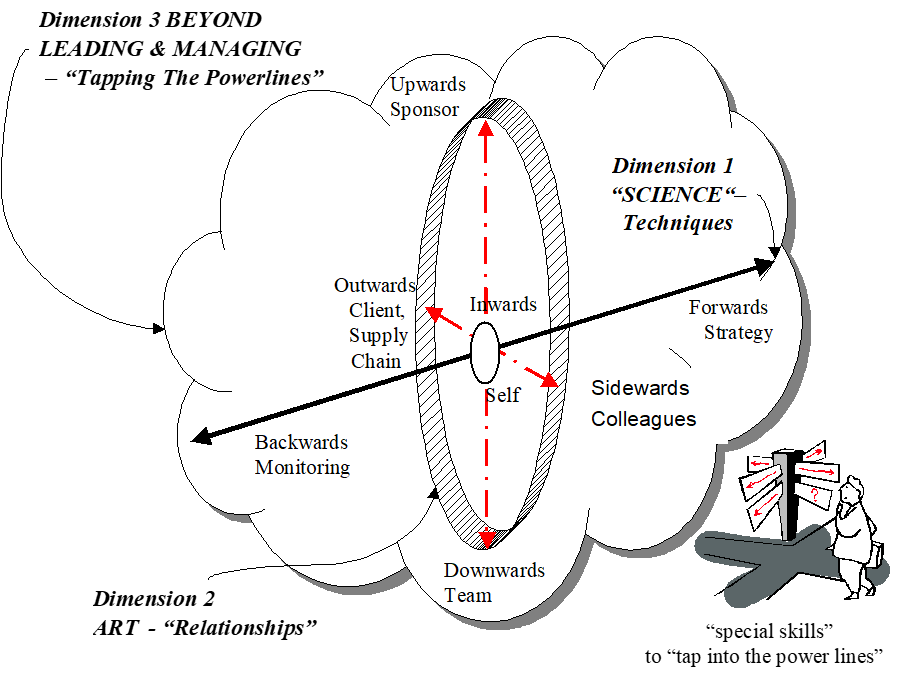
However, project management can also be seen as being about managing change, and project managers should be considered as change agents. This is a particularly relevant view when considering non-traditional, non-construction projects such as those in the sphere of IT or business process change. Successful completion of the project deliverables depends on effectively using both the ‘hard’ skills (time, cost, scope - 1st Dimension) and the ‘soft’ skills (relationship management - 2nd Dimension) throughout the project lifecycle to fully address stakeholder expectations. Soft skills are required to facilitate the application of hard skills because it is people who realize projects, not techniques or hardware.
Project management does not occur in a vacuum. It requires an infusion of enthusiasm and commitment powered by the full range of project stakeholder energy sources, particularly from project management colleagues, that can be tapped much like connecting to an energy grid. The key is knowing how and when to connect to this organizational grid and identifying who the key connectors (stakeholders) should be. Without attention to the needs and expectations of a diverse range of project stakeholders, a project will probably not be regarded as successful even if the project manager was able to stay within its original time, budget and scope parameters.
PP: Advancing Project
Management in Learning Organizations. This
paper describes the 'third dimension skills', beyond the
traditional 'hard' and 'soft' skills, needed by project
managers to successfully deliver projects in large
organizations. The paper then considers how project
managers might achieve competence in managing the 'third
dimension' both through individual effort and with the
support of a learning organization.
This paper expands on 'Tapping the Powerlines'
below.
PP: Tapping the Power Lines (how to connect to this organizational influence grid). Successful completion of project deliverables depends on project management of both ‘hard’ skills (time, cost, scope—1st Dimension) and ‘soft’ skills (relationship management—2nd Dimension) throughout the project life cycle to achieve project objectives that fully address stakeholder expectations.
PP: The Accidental Project Manager – The Getting of Wisdom. The accidental project manager has lived in the folklore of business projects for a generation. This paper will discuss ways to help them increase their chances of achieving project success, including a description of the project management skills and tools needed for success including the Stakeholder Circle.
PP: The future of the PM Hero. The PM’s role is changing from a hero focused on the ‘iron triangle’ to a business leader. Project success is no longer being measured simply in terms of time and cost, but by value created and stakeholder satisfaction. This paper outlines the skills needed to succeed in this emerging environment.
PP: Supersizing PMO
Performance. The value of a PMO to its host
organization is directly linked to its ability to
communicate effectively with both senior management and
project teams, in an appropriate language. To facilitate
access to the information it needs and to have its reports
and messages understood and acted upon. By understanding
its stakeholders and customizing its communication
strategy to meet their different requirements, the PMO
becomes a significantly more valuable resource. For more
on PMOs see: PMOs (Project,
Program or Portfolio Management Offices)
Chinese
language version.
 For papers on stakeholder engagement presented
at the PGCS Annual Symposium see:
For papers on stakeholder engagement presented
at the PGCS Annual Symposium see:
https://www.pgcs.org.au/papers/general-management/