Location:
PMKI > Project
Controls and Scheduling > CPM
Schedule Management - Overview.


- Scheduling overview
- The role of scheduling in support
of project delivery
- Schedule Challenges & Issues
- Traditional
scheduling challenges
- Schedule
control in Agile and Distributed projects
- Technical Debt
- Useful External Web-links &
Resources.
Other related sections of the PMKI:
- Schedule Strategy,
Planning & Design
- Schedule Development &
Time Analysis
- Resource & Costs
Analysis
- Authorizing &
Maintaining the Schedule
- Schedule Risk Assessment
- Scheduling Complexity &
Mega Projects
- Schedule Quality Assessment
- Work Performance
Management
- Forensic analysis
The critical path method (CPM) is defined as: a deterministic approach to developing a project schedule based on creating and maintaining a network diagram that reflects the logical sequence of activities that must be completed to accomplish the work of the project, and based on this model calculate the minimum duration needed to complete the project, and the amount of scheduling flexibility on each of the logical network paths defined within the schedule.
The critical path, after which the method is named, is defined as: the sequence of activities that determine the earliest possible completion date for the project or phase.
Note: The CPM calculations that determine the timing of each activity and the critical path may be based on the activity durations and calendars (Time Analysis), or also include consideration of the activity resource requirements and resources available to the project (Resource Analysis).
Much of the information available on this website has been consolidated into two easy-to-read books Easy EVM and Easy CPM:
 Both are designed as a course-in-a-book to provide
practical training and guidance to individuals and
organizations involved in developing or using, either
earned value management, or CPM schedules based on the
Critical Path Method (CPM).
Both are designed as a course-in-a-book to provide
practical training and guidance to individuals and
organizations involved in developing or using, either
earned value management, or CPM schedules based on the
Critical Path Method (CPM).
Easy CPM is designed to act as a reference
and practice guide for people implementing CPM scheduling
after they have learned to use the CPM scheduling software
of their choice.
See more, free preview and buy
($35, immediate download).
Easy EVM is designed to provide practical
guidance to people, and organizations, involved in either
implementing an earned value management system, or using
information created by an earned value management system.
It provides guidance on concepts, responsibilities,
integration, and processes, for the implementation and use
of earned value management based on ISO 21508.
See more, free preview, and buy ($35, immediate
download).
DP: A Guide to Scheduling Good Practice This free paper provide guidance on generally accepted good practices for the development of an effective schedule as the project progresses from feasibility, to planning, to execution and control. It describes the work undertaken by a scheduler to create a technically correct, 'dynamic schedule' and is consistent with the PMBOK® Guide and the PMI Practice Standard for Scheduling. Open the paper.

 The
need for good scheduling practice: The disastrous
state of schedule practice in the construction industry is
detailed in the report Managing the Risk of Delayed
Completion in the 21st Century [or download the smaller executive summary].
Between December 2007 and January 2008, The Chartered
Institute of Building (CIOB) conducted a survey of the
construction industry’s knowledge and experience of
different methods of project control, and time management,
record keeping, monitoring and training. Their findings
suggested there was a lot of work needed to achieve
general 'best practice', unfortunately observation of
general industry suggests the need is still as great
today.
The
need for good scheduling practice: The disastrous
state of schedule practice in the construction industry is
detailed in the report Managing the Risk of Delayed
Completion in the 21st Century [or download the smaller executive summary].
Between December 2007 and January 2008, The Chartered
Institute of Building (CIOB) conducted a survey of the
construction industry’s knowledge and experience of
different methods of project control, and time management,
record keeping, monitoring and training. Their findings
suggested there was a lot of work needed to achieve
general 'best practice', unfortunately observation of
general industry suggests the need is still as great
today.
Prs: (The)
Effective Management of Time in the 21st century.
This paper overviews a range of ideas to assist in the
effective management of time including:
- The need for effective planning ahead of scheduling and
the different objective of these two processes.
- The concept of ‘schedule density’ and the need to
schedule at an appropriate level of detail based on
the contemporary knowledge available to the
project team.
- The need for on-going dynamic scheduling to manage time.
- The need to contemporaneously assess the impact of
delaying events in real time based on accurate
and current schedules to allow effective
mitigation.
- The need for effective training and credentialing of
planners and schedulers.
PP: Calculating Completion. Tools used for assessing status, and predicting the completion of projects include: Bar Charts, Burndown Charts, Kanban Boards, Velocity, CPM, EVM + ES, and Work Performance Management (WPM). This paper considers each of these options against a highly simplified project, with a focus on the subjective and objective information available from each tool and how they compare. Download the original PMWJ version of this paper.
PP: Improving Schedule Management. When used as a dynamic motivational tool, focused on maintaining the momentum of work on a project, the schedule has much to contribute to the overall success of ‘modern project management’ in the 21st century. Project Management grew out of the ideas of Scientific Management, and the catalyst for the emergence of PMI and other associations was the rapid spread of scheduling in the 1960s. However, the emergence of the ‘knowledge worker’ and ‘soft projects’ is challenging the concepts of ‘command and control’ derived from Scientific Management and embedded in traditional scheduling practice. Modern business projects are complex and dynamic; new paradigms are emerging based on complexity theory and social network theory; and these ideas challenge the traditional role of the ‘contract schedule’.
This paper explores these emerging ideas and defines a new role for the project schedule and the project scheduler within the complex, dynamic, collaborative environment that defines many modern projects and programs. The schedule shifts from posing as an ‘accurate prediction of the future’ (if this was ever possible) to a dynamic tool used for communication, coordination and motivation of the project team. The key focuses for effective schedule management in the 21st century and the attributes required of a ‘good schedule’ and an ‘effective scheduler’ are described; defining a new role for the project schedule and the project scheduler within the complex, dynamic, collaborative environment that defines many modern projects. . Download the paper.
Art: Is Planning Predictive or Persuasive? Do project plans predict or create the future? While schedules on occasion may become ‘self-fulfilling prophecies’, is this because the schedule was an accurate predictor of the future, or did using the schedule change behaviors? This article suggests that too much emphasis is placed on developing ‘perfect plans’ that attempt to accurately predict future outcomes (a passive process), and not enough on using the planning and scheduling processes to proactively influence the future direction of project work.
PP: 5-STEPS, Five Steps To Ensure Project Success. The ‘5-STEPS’ methodology is a proven process designed to focus the thinking of the key Stakeholders onto the parameters required to achieve a successful project outcome. The process is a logical sequence of activities (and importantly, agreements) but recognizes iterative passes through some of the key steps may be required to achieve agreement. The five sequential steps are:
PP: Mathematics Matters in Project Management. This paper takes an overall look at the role of effective project planning and scheduling in the delivery of successful projects. It suggests an investment of between 1% and 2% of the project budget in effective project controls, to fund the use of the right combination of skills, software, and process can make a significant difference in delivering the scope of a project on time!
Prs: Time management -v- Contract administration. Delayed completion affects IT, process plant, oil and gas, building, civil engineering, shipbuilding and marine work contracts. In fact it affects all industries in all countries and the bigger the project, the more damage delayed completion causes to costs, to reputation and sometimes, even to the survival of the contracting parties themselves. Without effective time management there can be no effective resource management, cost management or delay management. Unfortunately, despite the obviousness of this proposition, far too many contracts and contract programs seem designed as highly detailed, ridged mechanisms for measuring failure; rather than using the schedule as a tool for proactively managing time to the benefit of all of the parties to a contract.
Although much has been written about how to apportion liability for delay after a project has gone wrong there was, until recently, no guidance on how to manage time pro-actively and effectively on complex projects. This paper seeks to address this imbalance by focusing on the effective management of time in the 21st Century. This paper defines the standards by which project schedules should be prepared, quality controlled, updated, reviewed and revised in practice to effectively manage time. And then describes the standards of performance which should reasonably be required of a project scheduler. It will contrast the static approach to scheduling defined in most contracts with The Guide’s logical step by step procedures to manage time from inception and risk appraisal, through design and construction to testing and commissioning, to show how an effective and dynamic time model can be used to manage the risk of delay to completion of complex projects. And will demonstrate that as a practical treatise on the processes to be followed and standards to be achieved in effective management of time, The Guide is a scheduling reference document capable of wide application. It can be used in any jurisdiction, under any form of contract, with any type of project and should be identified as the required standard for the preparation and updating of contract programmes, progress reporting and time management. Download the presentation.
Prs: Project
management vs Project scheduling. This
presentation focuses on the differences between successful
schedulers and successful project managers and how
together they can create successful project outcomes. Key
elements of the paper are:
- The role of the project scheduler – supporting project
success
- The key attributes of a successful scheduler (we’re not
project managers!)
- The emerging framework for scheduling and project
management – standards and certifications
- How to maximize the value contributed by skilled
schedulers – they are a scarce resource.
Download
the presentation.
Blg: Project Planning. The ‘Introduction to Project Planning’ published by Association for Project Management (UK) is a high level overview of all of the planning processes needed for a successful project outcome including scope, risk, cost, schedule, quality, procurement, resources and earned value.
 Time IS NOT Money. “Time
is not money; with money you can put it on the table and
you can see it, and if you leave it, it may even
accumulate - whereas with time, you can’t see it or
touch it. It expires at a regular and consistent rate
whether you use it or not.” - Read the interview Time is NOT
money', a conversation with Keith Pickavance
for some background on Keith's assertion the 21st Century
will be 'The Age of Time'.
Time IS NOT Money. “Time
is not money; with money you can put it on the table and
you can see it, and if you leave it, it may even
accumulate - whereas with time, you can’t see it or
touch it. It expires at a regular and consistent rate
whether you use it or not.” - Read the interview Time is NOT
money', a conversation with Keith Pickavance
for some background on Keith's assertion the 21st Century
will be 'The Age of Time'.
Traditional scheduling challenges
Prs: Project Controls
- The art of predicting project completion. A
good baseline schedule is not enough. This presentation
looks at implementing the USA Government Accountability
Office (GAO) Guide to scheduling good practice.The
Guide includes, and this presentation discusses:
- A set of 10 best practices
- An assessment guide
- The requirement to include risk and uncertainty in the
schedule
- The need for proactive ongoing management.
PP: Calculating Completion. Tools used for assessing status, and predicting the completion of projects include: Bar Charts, Burndown Charts, Kanban Boards, Velocity, CPM, EVM + ES, and Work Performance Management (WPM). This paper considers each of these options against a highly simplified project, with a focus on the subjective and objective information available from each tool and how they compare. Download the original PMWJ version of this paper.
Prs: Baked In Optimism – Why so many projects fail. This presentation looks at two processes that are ‘baked into’ standard project management estimating and control to show how recommended good practices are still optimistically biased. When preparing an estimate good practice recommends using Monte Carlo to determine an appropriate contingency and the level of risk to accept, but the typical range distributions used are biased – they ignore the ‘long tail’. When reporting progress, the estimating bias should be identified and rectified to offer a realistic projection of a project outcome. Standard cost and schedule processes typically fail to adequately deal with this challenge meaning the final time and cost overruns are not predicted until late in the project. This presentation highlights some of the causes for these problems - View the webinar on our Risk Assessment Page.
PP: Why Critical Path Scheduling (CPM) is Wildly Optimistic. CPM tends towards an optimistic representation of the project’s completion date. Used appropriately, this can be a performance motivator. However, prudent management also requires an accurate prediction of the completion date. The ‘critical path’ methodology developed in an environment of certainty. This paper suggests that when dealing with major projects in the modern age, the projected end date calculated by CPM tends to be widely optimistic. However, through the prism of complexity, in particular CRPR, and/or motivational theory this is not necessarily a bad thing. The factors that drive CPM towards an optimistic initial assessment include psychological biases, single point estimates, and limitations of the CPM modelling process (including a factor previously identified as PERT Merge Bias). As work progresses, these initial biases are compounded by the inability of CPM to adjust future predictions based on performance to date. Some of the solutions developed from EV theory such as ‘Earned Schedule’ provide a partial answer but are also limited. From the perspective of CRPR and motivation theory, having an optimistic schedule can be beneficial. The challenge is fitting an optimistic scheduling process within the constraints of an organizational governance structure that requires an accurate prediction of the likely completion date and traditional contracts that demand a ‘contract schedule’ and include significant sanctions if the CPM schedule predictions prove incorrect. Download the paper.
Blg: The Last Planner and other Old Ideas. The Last Planner® methodology has at its root, the idea that the best people to involve in the planning process are the front line supervisors and team leaders who will actually have to do the work. This is a really great idea!
Prs: Avoiding the 'Tipping Point to Failure'. Delivering ‘on the promise’ to meet client and stakeholder expectations requires project organizations that are capable of accomplishing the work! Whist this statement is obvious, most organizations remain blissfully unaware of Gladwell’s tipping point. The tipping point marks the boundary between linear changes and catastrophic change and unfortunately, it is impossible to predict where a tipping point may occur until after it has been reached.
The reason this is an important consideration for all project managers and project organizations is that leading up to the tipping point, increases in project complexity have predictable increases in difficulty and the situation is manageable. Once the tipping point is reached, the situation flips from predictable and manageable to unmanageable within the current context. New paradigms are needed to first stabilize the situation, then recover. But there is no fixed point for the change; the tipping point is influenced by the capability of the performing organization and its people and the degree of complexity of the work they are asked to accomplish.
The degree of complexity associated with the work of the project increases exponentially and is influenced by a combination of its inherent size, technical difficulty, intensity, and the surrounding stakeholder relationships. Each performing organization can manage a level of complexity based on its prior experience, maturity, supporting systems and the capability of the people managing the work. As long as the ‘complexity’ is within the management capability of the organization and the people it deploys, reasonably predictable outcomes can be expected and normal risk management practices are likely to be effective. Change any of these parameters to the point where the overall tipping point is reached and there is a sudden breakdown that causes a significant negative change in the likely project outcomes. Recovery is no longer a simple process of marginally increasing the resources deployed, what’s needed is a massive change in the capability of resources.
This presentation:
- Explores the concept of a ‘complexity quotient’ and
identify elements that are controllable by the
organization such as optimizing the amount of
information in the project control systems.
- Examines the concept of the tipping point and highlights
the role of project 'control' systems in
identifying potential early warning
indicators that may be used to see the 'tipping point'
approaching.
- Considers how an organization can deal with a project
that has ‘tipped’ either as the consequence of
an unforeseeable event, a ‘black swan’, or
through an inexorable build up of complexity within the
work.
- The concept of organizational resilience is defined.
The tipping point is not fixed for any organization, by developing improved systems and acquiring experience the organization can grow to be capable of managing larger, more complex projects. The challenge is to achieve this growth without running into a tipping point.
Schedule control in Agile and Distributed projects
This section looks at the challenges of scheduling, managing, and claiming delays in agile and distributed projects using traditional forms of contract. Distributed projects have two dominant characteristics, the majority of the work is comprised of a series of physically separated units that are similar or identical in design, and the logical dependencies between the different units are either non-existent or minimal (think of an off-shore wind farm)*. In this type of project, most of the components are identical and can be used anywhere, which means the work can be planned in almost any sequence, and that sequence can be easily change

This paradigm is similar to those found in projects using agile and lean approaches where the sequence of working is largely chosen by the people doing the work based on their view on the 'next best things to do' in the next sprint or the next month. The an overview of the agile approach to software development are outlined at Agile Approaches to Development.How this appraoch achieved its current level of acceptance is discussed in The History of Agile, Lean, and Allied Concepts.
These types of project is not well supported by either traditional CPM scheduling, ‘line of balance’, or other traditional project controls paradigms. The challenge is compounded by the fact that some projects are suited to the underlying principle in CPM which assumes there is one best way to plan and deliver the works, others have no preset requirements for the work sequence and others have some level of mandated logical sequence that affects some parts of the work, but not others.
The primary consideration in planning and managing this type of project is optimizing resource flows. The consequences of re-sequencing if needed are not based around traditional CPM logic, rather an assessment of the loss in resource efficiency which is much more difficult to assess and measure. This is particularly true when you need to separate productive efficiencies under the control of the contractor from disruption caused by the re-sequencing.
Prs: Scheduling Challenges in Horizontally Distributed Projects. This initial presentation defines the concept of a horizontally distributed project, and then based on some practical examples, highlights the challenges of assessing delay and disruption based on traditional paradigms of CPM scheduling. It will conclude by offering suggested ways to adapt project controls and contractual requirements to provide a sensible assessment of project delays. This presentation considers:
PP:
Scheduling Challenges in Agile & Distributed
Projects. The focus of this paper is to define
the challenge and look at practical options for managing
work efficiently in a wide range of projects where the CPM
paradigm does not apply. Including those using various
agile and lean approaches, other soft projects, and
distributed projects. The paper:
• Briefly defines the management assumptions that support
the use of CPM scheduling, its origins,
and limitations
• Develops a classification framework of project
characteristics to help define the potential usefulness of
CPM scheduling across different project types
• Briefly describes some of the management approaches
currently used in non-CPM projects including
agile and lean, their benefits and
limitations
• Considers the application of the framework discussed
above applied to a typical wind farm project, and
• Develops general recommendations for the management of
non-CPM projects focused on optimizing
the efficient use of resources in agile
(soft) projects and distributed projects.
There may be a high level ‘road map’ outlining the desired route to completion and/or specific constraints on parts of the work in both soft and distributed projects, but there remains a lot of flexibility in the way the work is accomplished. And, in many cases there is a deliberate management intent not to follow a predetermined sequence of activities defined in a CPM schedule! The focus of this paper is to define the challenge and look at practical options for managing the work efficiently. Download the original PMWJ version of this paper.
 One solution to the challenge
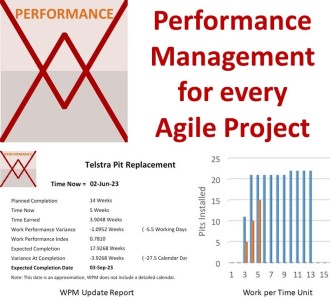
described in this paper is Work Performance Management
(WPM)
One solution to the challenge
described in this paper is Work Performance Management
(WPM)Click through to see more on Work Performance Management.
Download the Work Performance Management Spreadsheet.
PP: Calculating Completion. Tools used for assessing status, and predicting the completion of projects include: Bar Charts, Burndown Charts, Kanban Boards, Velocity, CPM, EVM + ES, and Work Performance Management (WPM). This paper considers each of these options against a highly simplified project, with a focus on the subjective and objective information available from each tool and how they compare. Download the original PMWJ version of this paper.
PP: Assessing Delays in Agile & Distributed Projects. The internationally recognized approaches to assessing delay and disruption are based on the premise there is a well-developed critical path schedule that defines the way the work of the project will be accomplished. Critical path theory assumes there is one best sequence of activities, that have to be completed in a predefined order to deliver a project successfully. Therefore, events that delay or disrupt activities in the schedule can be modeled, their effect assessed, and responsibility for the assessed delay assigned to the appropriate party. The focus of this paper is to offer a practical solution to the challenge of assessing delay and disruption in agile and distributed projects where the traditional concept of a ‘critical path’ simply does not exist and the effect of intervening events has to be considered in terms of loss of resource efficiency. Click through for more on Forensic Schedule Analysis.
Technical Debt
Art: The Insidious Effect of Technical Debt - The concept of technical debt refers to the costs of having to go back and resolve problems that arise because an earlier decision was made to take an easy option, instead of the best one.
Prs: Who's Cross about Crossrail? The insidious effect of Technical Debt - A review of the £2billion cost blow out and 2 year delay in the London Crossrail project as seen in 2019, caused by a combination of technical debt and poor governance. The final outcome was a delay of 4 years to full opening and a £2billion cost blow out.
PP: Scheduling in a Defence Environment. The primary purpose of any schedule should be to help the project manager and project team optimize the overall strategy for the delivery of the project, coordinate work flows and assist in the decision making processes needed to resolve dilemmas and issues on a day-to-day basis. This paper identifies some of the symptoms of scheduling failure and then addresses three topics; a discussion of the real purpose and usefulness of scheduling. the current ‘state of play’ in the development of scheduling and some emerging trends that may re-focus scheduling. Download the paper.
Access the Guild of Project Controls Body of Knowledge. A suite of process-based documents which define Project Controls (membership required): http://www.planningplanet.com/guild/GPCCAR-modules
 For papers on Scheduling presented at the
PGCS Annual Symposium see:
For papers on Scheduling presented at the
PGCS Annual Symposium see:
https://www.pgcs.org.au/papers/scheduling/